
Case study · FreeFrom
How FreeFrom built trauma-informed interview protocols with Chayn’s White Paper on Trauma-Informed Design
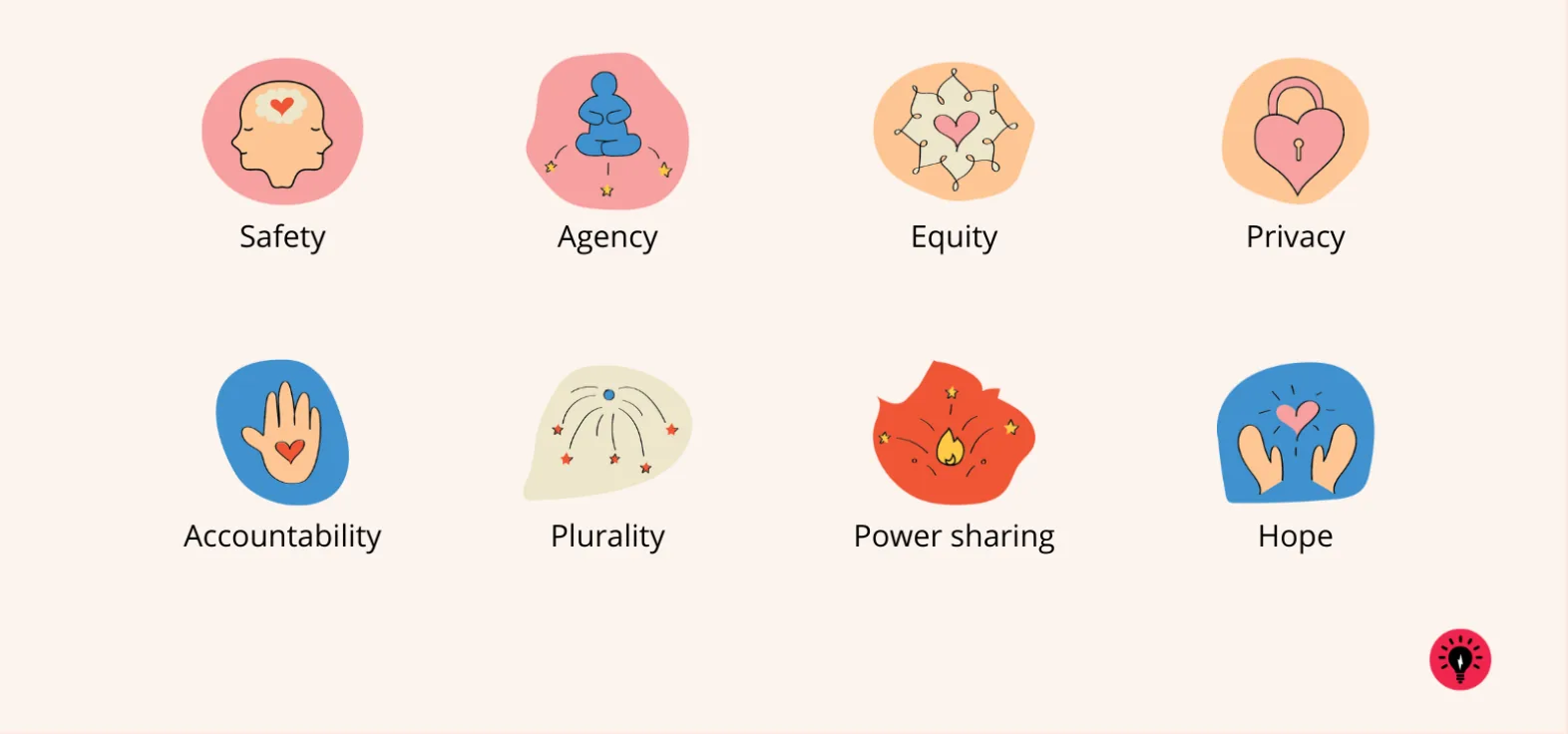
As FreeFrom was updating its trauma-informed protocols for interviewing survivors, the team drew on Chayn’s White Paper on Trauma-Informed Design as a guiding resource. They adapted and incorporated its eight principles into their own internal guide for conducting focus groups and interviews.
Plenty of guidance on trauma-informed design, but none that fit their needs
FreeFrom operates at the intersection of gender-based violence (GBV) and financial security, an aspect of harm that often goes unaddressed. Their mission is to end GBV by building economic freedom and safety with survivors, before, during, and beyond moments of crisis. One thing that makes their organisation distinctive is their survivor-centred approach. As Pilar, FreeFrom’s Evaluation and Impact Manager, shares, “FreeFrom is a team primarily made up of survivors, so it’s an issue that’s very personal to a lot of us.”
The team used Chayn’s White Paper to update its protocols for conducting trauma-informed focus groups and interviews with survivors, conversations that inform everything from programme design to their public storytelling and policy advocacy. Some team members would be facilitating focus groups for the first time, and much of the work now happens online. The design principles helped inform an internal guide that offers structure while preserving the flexibility to follow survivors’ leads.
There was no shortage of material to draw on, in fact Chayn has a blog series that covers our approach to trauma-informed user research. “There’s a ton of research and resources out there,” Pilar notes. What they needed was something practical enough to hand to a facilitator, and flexible enough to adapt to the survivors in the room rather than overly prescriptive frameworks.
Adapting Chayn’s white paper into their own guide
Pilar first encountered Chayn maybe five years ago, before she was working in the field of gender-based violence. “When I went to the website and started looking around at some of the resources, and the tools that were there, and even the website itself,” she recalls, “it seemed like there was a ton of care and intentionality.” That impression resurfaced years later when she began working at FreeFrom.
Two things made Chayn’s White Paper on Trauma-Informed Design stand out. First, accessibility. The information was practical and usable, not academic or abstract. Second, it offered flexibility. “A lot of times people are given a tool, and they’re like, this is how you should do this work,” Pilar explains. But working with survivors “require that flexibility and being adapted and following survivors’ leads.”
This meant FreeFrom could take what worked for their organisation, the sections on advocacy, confidentiality, and building trust, and adapt them into their own internal guide for focus groups and interviews, using the whitepaper as a reference. Because so much of FreeFrom’s work is virtual, the paper’s specific considerations for online settings were, as Pilar puts it, “very applicable.” She also shared widely: “I shared it with my colleagues [both within and beyond FreeFrom] who [have] also implemented it in their own work.”
Making survivors feel safe from the first conversation
Team members new to facilitating focus groups found the adapted guide invaluable. “It’s a resource that we continue to refer back to whenever we’re conducting focus groups or interviews,” Pilar says.
Survivors themselves were also happy with the result. “We got really good feedback from the survivors themselves who participated,” Pilar shares. Many told them:
We felt super safe, we felt there was trust, even though this was the first time that we were meeting each other in this context.