

The courses gave me the understanding and language, then the one-on-one chats gave space for a voice to emerge. They provided a feeling of safety via warmth and ‘withness’, where I always felt welcomed, always felt like that space was open for me whenever I needed — without feeling like there were time restrictions, or like I might be a burden to someone’s time.
Impact report
Our 2023–2024 Impact Report
A year of deepening our expertise, growing our reach, and supporting more survivors than ever — across more of the world.
2023 was major for Chayn! First and foremost, we welcomed three Chayn babies into the world — all of them boys. The Chayn family supported our senior staff — including our CEO, our Head of Product and our Head of Movement Building — as they took time out to become first-time mothers. For the organisation, it was a time of shifting and sharing job roles, while experimenting with more of a distributed leadership model.
2023 also saw us deepen our expertise in the online safety and tech-facilitated gender-based violence (TGBV) spaces. We created brand new content around this topic for survivors, and made strides with our movement-building work to advocate for this issue in UK and international policy conversations.
Our partnership work with Bumble has also grown significantly. We’ve offered support to many thousands more survivors through our Bloom service in the last year. We’ve worked hard to expand our reach in the Global South, with people accessing our resources in more than 70 countries and 14 languages. We’ve made our Bloom service more useful — through listening to survivors and redesigning aspects of it in line with their needs. We also launched a new service, Diya, focused on supporting staff within organisations as they encounter vicarious trauma in their work.
Our impact measurement journey
We haven’t done an annual report for a couple of years. That’s because, for the first time, we have done deep work on our impact measurement approach and data gathering, with the help of our Head of Research, Jenny.
This has been a journey of prototyping and iterating, defining and reframing. We’ve created a method that allows us to review each of our products and services within a single framework, over time. We’ve figured out what data we need to gather, what it tells us about our work’s impact, and what the gaps are. We’ve balanced trade-offs and ethical decisions — such as deciding how we can collect feedback while respecting our users’ privacy, GDPR, and behaving in a way that’s non-extractive.
We’ve planned how both qualitative and quantitative data will play a role, and tried various methods of data collection. We’ve explored what ‘good’ looks like when it comes to healing, and revisited our Theory of Change. And of course, we’ve tried to do all of this in line with our trauma-informed principles. And when our users say things like the quote below, it makes it all feel worth it. Let’s dive in…
This whole thing makes my heart warm up — it’s like chicken soup for my survivor soul.
Chayn’s mission
Chayn creates resources and services for and with survivors around the world, to support them on their journey of healing. Our work helps survivors identify abuse, understand their trauma and the impact of misogyny on their life, and take control of their recovery pathways. We share these resources generously and openly for anyone to use or adapt.
By challenging patriarchal narratives in the media and the web, we contribute to creating a hopeful and just world. Working in the open encourages our peers to open up too, leading to the wider adoption of trauma-informed, survivor-centred and intersectional approaches to helping survivors live better lives. Chayn works to build a better future for technology by modelling its transformative potential, and advocating for safe, open-source solutions which serve everyone.
Our 2022–2025 strategy laid out some bold ambitions for us as an organisation. We aimed to increase the number of survivors we support, and grow our movement-building activities in the GBV and TGBV spaces, particularly in the Global South.
This report is split into two key sections — 1) Survivor impact and 2) Movement-building impact — to share the kinds of work we’ve been doing to progress in both areas.
Part one
Survivor impact
In our 2022–25 public strategy, we introduce that our approach to measuring survivor impact will be on two axes: Reach and Depth. We have specific impact targets for each.
Reach means how many people around the world use our services, as well as where they are located. We are focused on increasing the number of survivors accessing our services to 1 million, with a particular focus on increasing access for those located in the Global South.
Depth means how survivors are using our resources and what kind of impact this is having for them. We are aiming for 80% of our user base to report that our resources have ‘transformational’ impact for them.
Survivor impact
Reach
Impact goal
Between now and 2025, our goal is to support 1 million survivors, and to extend our reach and impact with survivors located in the Global South.
Progress towards our goal
- We have focused efforts on extending our reach for people belonging to the Global Majority, with 138 of our individual resources now available in Spanish, Portuguese and Hindi. Over 190,000 users have accessed our resources in these languages — a third of our user base. 33 of our resources are now available in additional languages spoken in the Global South, such as Farsi, Pashto, Arabic and Urdu.
- The resources that have reached most visitors are Soul Medicine (43,472 users) and our DIY online safety guide (17,653 users), as well as Chayn’s India, Pakistan and Italy platforms (250,000+ users).
Survivor impact
Intensive support: Bloom
We created Bloom in 2020 as a response to the rise in domestic and intimate-partner violence sparked by the Covid-19 pandemic lockdowns, paired with the gaps in support for survivors that stemmed from many services closing at that time. Bloom provides free access to a range of supportive content co-created with survivors. There are five different courses to take, ranging from the most popular, ‘Recovering from toxic and abusive relationships’, to the newest, ‘Image-based abuse and rebuilding ourselves’.
Bloom also offers 1:1 therapy sessions for Bumble partner users, a 1:1 chat service run by our team of experts in GBV, an affirming WhatsApp service which sends messages of solidarity and hope twice weekly, and a broad range of grounding exercises and activities for survivors to try out in their own time. Take a look at the Bloom site.
- We had 8,575 users sign up for Bloom in 2023. This was a huge year for us and represents 93% of our overall Bloom sign-ups.
- 3,343 videos were played across the year. Our most-played course video was the introduction to ‘Recovering from toxic and abusive relationships’, followed by ‘What is sexual trauma?’ and ‘What are boundaries?’
- Over 500 survivors have accessed intensive and/or sustained support from us since 2022. Intensive support means they had a therapy session (currently available to Bumble partner users) or a 1:1 chat session, or watched three course videos (or opened three transcripts).
- Our team supported more than 400 users on 1:1 chat, and 175 people signed up for our Notes from Bloom WhatsApp service since it launched in March 2023.
Survivor impact
Depth: transformational impact
Impact goal
80% of survivors report that they find our services transformative.
We have broken down what we mean by ‘transformative’ into a few key areas that are measurable. In line with our Theory of Change of healing — informed by many years of supporting survivors — we believe ‘transformation’ occurs for survivors when the following things are happening:
- 1The survivor recognises their trauma.
- 2The survivor takes ownership of their healing.
- 3The survivor plans for an empowered future.
- 4The survivor ‘pays it forward’ — and becomes part of the fight against GBV.
This data is focused on Bloom, our most in-depth support service. Bloom requires a sign-in and encourages users to visit us multiple times, so it’s more straightforward for us to contact our users and gather impact data for this service than it is for some of our others.
Has using Bloom impacted you personally?
Results as of March 2024. Here we can see that 70% of Bloom users say it has positively impacted them, with a further 14% suggesting that they think it could do so in future. Only 2% say that it negatively affected them — this is to be expected in small numbers, because our content is focused on trauma and could be triggering.
What kind of impact has using Bloom had for you?
Select as many as apply. Results as of April 2024. The fourth factor — ‘The survivor pays it forward and becomes part of the fight against GBV’ — we measure with an NPS-style question (see below).
77% of survivors who have used Bloom (n=66) select at least one of these statements. 52% of them choose two or three of the statements, showing that for many survivors our Bloom resource is impactful in multiple areas of their healing journey — becoming more aware of their trauma, taking ownership of making steps towards healing, and imagining an empowered future for themselves.
“Help me take steps to support myself” was chosen by 60% of users, and came top. This makes sense, since we’ve recently added more tools to our Bloom platform which help survivors to support themselves in difficult moments. We did a significant piece of work to redesign our navigation and surface some of our more bite-size content, such as grounding exercises and activities. These are now much more visible and accessible to users, instead of being buried within course materials.
Not far behind, “Helped me to understand my trauma” was selected by 52% of users, which indicates that our resources are proving educational. Survivors tend to choose “Helped me to feel I can move forward with my life” less, at 39% — that’s likely to reflect where survivors are in their healing journeys when they come to us. In future, we could think about surfacing the support we have around this theme more clearly.
Likelihood to recommend
We ask: now that you’ve used a service, how likely are you to recommend that another person who has experienced abuse uses it? (On a scale from 1 — not likely at all — to 10, extremely likely.) Across Chayn services, survivors score their likelihood to recommend at an average of 8/10.
| Chayn site | Average score | Responses |
|---|---|---|
| Chayn.co | 8 | 107 |
| Bloom | 8 | 247 |
| DIY online guide | 9 | 3 |
| Getting Better | 4 | 3 |
| DA case | 8 | 14 |
| MIA | 8 | 50 |
| Good Friend Guide | 10 | 4 |
| Soul Medicine | 6 | 60 |
| YSM | 8 | 6 |
| Average / total | 8 | 494 |
The benefits and limitations of NPS as a metric: our funders like NPS; it is simple and well understood across sectors, and it gives us a high-level indication of whether survivors feel that our resources are useful enough to warrant sharing. It is also standardised, meaning we can use it across our services fairly easily. Given that most of our services don’t require users to sign up for accounts, using a tool like Hotjar to collect some feedback via NPS feels valuable, if flawed — without it we may have no data at all.
The drawbacks are the clear links between NPS and marketing, sales and commercial research. It’s not ideal in terms of tone for our sector — healing from trauma and buying products are very different experiences. There’s also the annoyance factor; lots of people don’t like pop-ups, or being asked whether they’d recommend a service they haven’t had much chance to use yet.
It’s worth noting that we’re careful with the language in our NPS question. We don’t ask survivors how likely they would be to personally share our resources with friends or family — we know they may not wish to do this, because they may not want anyone in their network to know they’ve experienced abuse. That’s why we ask the question in a more theoretical way. If anyone else in our sector is in this position and has creative ideas about collecting feedback, we’d love to talk.
Survivor impact
Survivor voices
The teachers kept saying it’s not your fault, and that’s very empowering. Also, to have the class must mean a lot of people have gone through something, so I feel less alone and ashamed.
I really thank Bloom for helping me learn a lot about trauma and how to transform my thinking from a very sad place to going on a healing journey. It transformed how I thought about my experiences — I finally named trauma in my life, and hadn’t done this before. I am learning about my needs, how to communicate them, and how they can be respected in healthy relationships.
I signed up right away — I am a survivor of domestic violence. It felt like the mothership calling… like the service I wished I had 15 years ago.
The courses helped, especially because I couldn’t put words to what I was experiencing, so the courses really helped me with navigating my experiences. They helped open up the ability to communicate about it.
The concept behind Bloom is fantastic and an unmet need. Free access to content tailored around understanding topics relevant to domestic abuse is critical for so many women who need support to understand what happened to them.
It’s nice to see the diversity from all over the world. Makes us feel like one.
Looking ahead
How we plan to drive more impact for survivors in 2024
We plan to stay focused on growing the reach and transformational impact outlined in our strategy. Bloom, our flagship online service for survivors, saw many iterations in 2023. This year will be about making sure it is in the hands of even more survivors, across even more of the world.
To do that, we’ll continue work on making it mobile-first, and we’ll be doing lots of outreach and comms work to ensure people know what it is and how to find it. We’ll be producing new content on digital safety — including cyberstalking and online harassment — to reach more survivors of TGBV. Finally, we’ll be creating content on somatics and body work in order to further support survivors’ healing through more holistic approaches.
With Bloom steadily growing, we want to turn our attention to the many other products and services in the Chayn universe. Over the last 11 years we’ve built up a huge bank of resources, and our website needs updating to make sure everything is listed there and is up to date. We’ll be doing some work to consider how we can help people in crisis find the support they need even more quickly.
Part two
Movement-building impact
One of Chayn’s goals in 2023 was to extend and deepen the support we offer to the movement to end gender-based violence.
By movement, we mean all of the organisations and individuals pulling together to challenge cultures, policies and practices that perpetuate harm against marginalised genders, spot and mitigate against abuse, and support survivors.
Movement building
Advocating for GBV on the global stage
In 2023 we welcomed Eva, our Head of Movement Building and Policy, and she’s been working to build connections with the Violence Against Women and Girls (VAWG) and digital rights sectors.
She’s also been consulting with tech firms and government bodies to advance the conversation around the harms of TGBV, and to advocate for more survivor-centred policies to promote online safety. We’ve been developing a strategy around AI — you might have seen our blog on the dangers of artificial intimacy and deepfakes. We were mentioned in Reuters, the Economic Times, and our founder was profiled in Mashable. Hera also did a string of news interviews — you can see them on our Instagram.
Some highlights
- Eva was invited to join a UN Expert Advisory Committee, set up to develop survivor-centric, human-rights-based guidance for advancing legislation to respond to tech-facilitated gender-based violence.
- Eva met with the UN Special Rapporteur on VAWG during her visit to the UK, at a roundtable with human rights NGOs, and presented Chayn’s recommendations on AI and TGBV.
- Eva engaged with Meta, who consulted us on their plan to implement end-to-end encryption on Facebook Messenger.
- Eva was asked to facilitate a meeting between the UK Commissioner on Domestic Violence and the US National Domestic Violence Hotline information exchange.
- Chayn was invited to join a panel by World Justice Project México on tech solutions to tackle GBV.
- Eva spoke at the European Conference on Domestic Violence in Iceland to share our Orbits work.
- Hera and Nadine co-authored a paper on our experience with chatbots and their limitations for the Social Innovations Journal, organised by Ashoka.
- Hera spoke at the UNFPA Global Symposium on TGBV, the No More Tech Abuse conference, and the first summit on deepfake abuse.
Movement building
Partnership impact in numbers
In the last year we’ve developed, prototyped and implemented our impact-measurement strategy — across our survivor-facing and sector-facing work. We have started to collect data that helps us understand whether our partnership activities are useful to other organisations and individuals working in this space.

Impact goal
Engage and work with 300 partner organisations between 2022 and 2025, with at least one third based in the Global South. How we’re doing: we shared our expertise with over 780 people and 187 organisations over the last two years, with 51% of those based in the Global South.
Impact goal
Have an impact on 100 organisations between 2022 and 2025 through training or Community of Practice activities. How we’re doing: we have positively supported over 72 individuals who have worked with us in some capacity, and we estimate they work for around 40 different organisations.
Thinking about your experience of this event or programme with Chayn…
A high proportion of people (87%) found joining our partnership events relevant to their work. The fact that Chayn provides learning materials in a way that’s easy to share seems to be working, with 75% of people stating intent to do so. When it comes to applying learnings in their own work, 61% feel confident they can, and 23% had already made use of recommendations or findings by the time feedback was collected.
Almost half said that joining Chayn for partnership activities helped them understand the wider context of GBV and/or tech, and just under a quarter felt that taking part had helped them feel able to cope with how their work affects them. These show definite opportunities for supporting partners further.
Movement building
Sharing our expertise in TGBV
In 2021–22 we collaborated with End Cyber Abuse to create Orbits — our field guide to advance trauma-informed interventions to tech abuse in tech, policy and research. It was the result of a series of participatory consultation workshops with people from across the world, including researchers, activists, campaigners, UX designers, and survivors. In the past year, we’ve been building on this work and sharing our expertise in the TGBV and online safety space.
We were invited to the UK Parliament to discuss deepfakes and TGBV, and were asked to facilitate or speak at many sessions — including the Global Symposium on TGBV organised by UNFPA, the Deepfake Summit by My Image My Choice, and a conference by No More. Eva was invited to take part in a Delphi Study organised by UCL to establish a consensus on how technology-facilitated abuse may be defined, conceptualised, and measured.
Eva attended a closed-door roundtable on technology and family and domestic violence, organised by researchers from Monash University at their campus in Prato, Italy. The Australian eSafety Commissioner was present and engaged with the points we made on TGBV.
A creative partnership
On the more creative side, we partnered with the producers and directors of the documentary Another Body as they launched and promoted it. It had its world premiere at South by Southwest, where it won the Special Jury Award for Innovation in Storytelling. It explores a college student’s search for justice after she discovers deepfake pornography of herself circulating online.
The team at Another Body hosted an event at the UK Parliament with MP Jess Phillips and invited Chayn to attend, and Eva hosted an Instagram Live interview of the directors that gathered 126 attendees. The topic aligns strongly with our passion for online safety, and coincided with the launch of our new Bloom course on image-based abuse. Eva also spoke on a panel at Bumble during the launch event for this course.
Going forwards
- We plan to publish a guide for US university students on deepfakes and TGBV, in collaboration with the producers and directors of Another Body.
- We’ll be campaigning about the role of AI in TGBV, using key recommendations from the Orbits report and advocating for more survivor-led interventions.
- We’ll be working with influencers across South Asia to highlight the issues of TGBV, and we’ll be designing a free workshop on TGBV and trauma-informed design for everyone working on this issue.
Movement building
Collaborating with our volunteer network
Chayn started as a volunteer-run organisation, and in 2020, when we transitioned to having paid staff as well, it was our goal to be a thriving employee–volunteer hybrid model. This worked well for the first two years, as the first staff were also previous volunteers and were accustomed to working in this way. As our staff team has grown and the staff members who used to be volunteers have moved on to other organisations, this has become harder — and it’s something we’re reflecting on.
In 2023, the Chayn volunteer team worked on our image-based abuse course, and collaborated with us to improve our popular Good Friend Guide. We hope to launch it later this year.
Movement building
Sharing our expertise in trauma-informed design
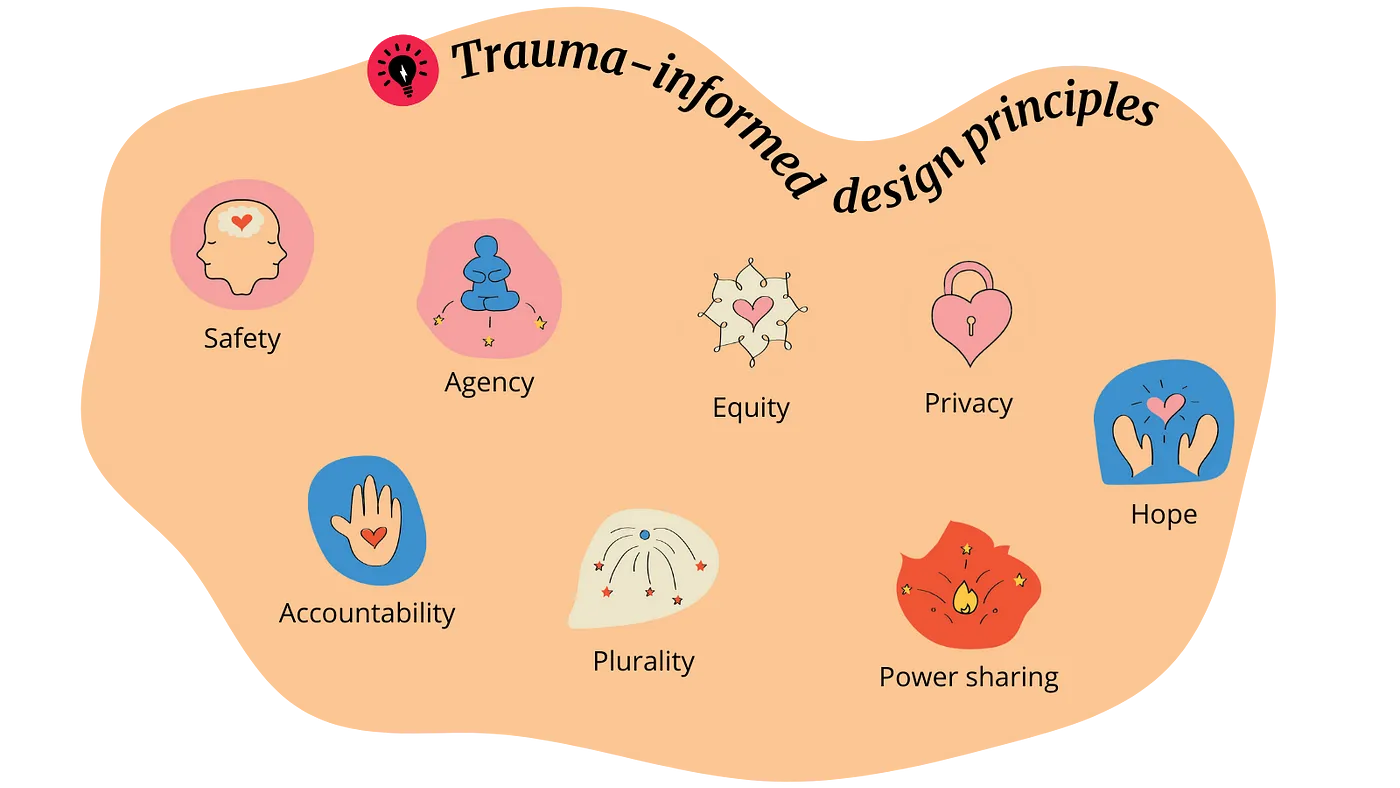
In 2023 we wrote and shared a white paper covering how we bring our trauma-informed principles to life in four key areas: our service design, our research, our policy development and our organisational design.
We also published tips and guidance around applying the trauma-informed principles to user research through a series of five blogs, which have been read by over 1,400 people so far.
One of the areas we’re asked most about is our expertise in trauma-informed design and research. We are creating a resource hub to house all of our materials. We also shared a number of blogs about how we run as an organisation, which is part of our commitment to sharing openly:
- How Chayn runs its team retreats — a mix of self-guided and group sessions to encourage team collaboration and reflection.
- Gratitude Robin — a yearly activity to deliver a bouquet of love to people you work with.
- How we made an award-winning podcast as a small non-profit — the wild journey that led to almost not making Less than 2%.
Movement building
Trauma-informed design workshops
In these workshops we share practical, tangible tips from our 10 years of survivor-led experience, as well as holding space for participants from many organisations to share what helps or hinders them from adopting these practices.
We held a free, two-hour trauma-informed design workshop in June 2023 and another in February 2024. 217 people attended the workshops and 212 watched the recording afterwards. We made the workshop recording and materials free to access for anyone — we encourage readers to use and share it.
What attendees said
Hera was such an inspirational, relatable, engaging presenter. I’ve been reading your blogs for a while and love the work you do — but it was so great to hear directly from Chayn’s team. I also love the ethos of sharing the knowledge with others, for free no less! Amazing.
You are truly expert, professional and trusted to work with. Chayn collaborate with other organisations in a way that strengthens our ecosystem rather than creating competition or division.
It was relaxed, safe and informative. Fantastic, thank you.
I really appreciated Hera’s humility, transparency, and focus on learning. It helped to create a safe space for creativity and collaboration.
Thank you so much for such a robust free workshop on an important topic!
I really appreciated the mutual safety and sharing that the group had. I also really liked the explanation of Chayn — what you do, why you do it, and how you learn, grow and adapt your resources. Truly inspiring, thank you!
Thanks for integrating me as an outsider — it was great meeting the activists and support workers from around Europe!
Overall this was a fantastic workshop. I learned so much, and it helped me see accessibility, and design in general, in a new light.
Movement building
Launching Diya
In 2023, we launched a new service! Internally, we had been reflecting on the need to create a programme around vicarious trauma, and having been part of some sector-wide discussions where this was a recurring topic, we decided to delve into it — for ourselves and our peers in the field. We were successful in getting a grant from an EU-funded project called Resistiré. Through this we developed the first version of this programme, which was piloted and delivered to 16 front-line human rights organisations across Europe.
This had a very positive response, and we decided to expand the programme into a revenue-generating service, and called it Diya (meaning an oil lamp in Hindi, often used as a symbol of hope). Diya is designed to support organisations whose staff encounter traumatic content in their day-to-day jobs.
In 2023, we delivered the pilot programme for Bumble, focusing on supporting their member safety team through the vicarious trauma that arises as they field and respond to the thousands of reports of abuse that occur daily on the platform. Over the six-month period, the partnership enabled us to deepen our own expertise in the topic, and share the kinds of supportive policies and practices that can help employees protect themselves.

Diya pilot programme highlights
A key insight from this pilot is that while our content can be centred around what we know from research and working with therapists, our suggestions around policies and practices need to be more bespoke — aligned with what the organisation can realistically do and is incentivised to do. The interventions that may be possible for us at Chayn or other non-profits are not always relevant for corporates and tech organisations.
In 2024, Diya will continue, and be improved with the support of a dedicated project manager for Bumble and a specialist in vicarious trauma. We are also offering Diya to other organisations — so if you are interested, then let us know at partnerships@chayn.co.
Movement building
Sharing our strategy process openly
We’re always interested in stories of impact — and particularly whether our working-in-the-open policy is reaching people in meaningful ways.
Last year, La Sobremesa — a civil society organisation working in Latin America — contacted us to share that they’d been directly inspired by our process of openly creating our 2022–2025 Chayn strategy. Read all about it in this case study.
If you have been impacted or inspired by Chayn’s work and approach, then we would love to hear about it! Please contact us to chat more about sharing your story: jenny@chayn.co.
Looking ahead
How we plan to drive more impact in 2024
Summer of 2025 marks the end of Chayn’s 2022–25 ‘lived-in’ strategy. In the run-up to that, we’ll be using what we’ve learned over the last few years about how to measure and grow our impact, and applying it.
- 1We’ll be building a resource hub to host open-source content, providing free access to our trauma-informed practices and our Bloom content in new languages, for use by VAWG and migrant-focused networks and organisations.
- 2We’ll update and formally launch our ‘org’ website to allow partner organisations to better understand our role and activities, and link to our resources.
- 3We plan to invest in more network-building and outreach with migrant justice organisations in the UK, to reach more survivors — especially those from migrant and conflict backgrounds, in their languages.
- 4We’ll continue sharing our thinking about trust and safety in the technology space to influence research, policy and design.
- 5We’ll also host more free trauma-informed design workshops for the movement.
If you are interested in working and partnering with us on any of these activities, then please reach out to partnerships@chayn.co. And if you have any further feedback, questions or comments on this report, get in touch with jenny@chayn.co.